All projects
02 / hardware & exploration

Pi Constellation
Mapper

A portable window into the night sky. Part field instrument, part sketchbook for the patterns you find overhead.

Raspberry Pi / In progress

The sky on screen

Software prototype
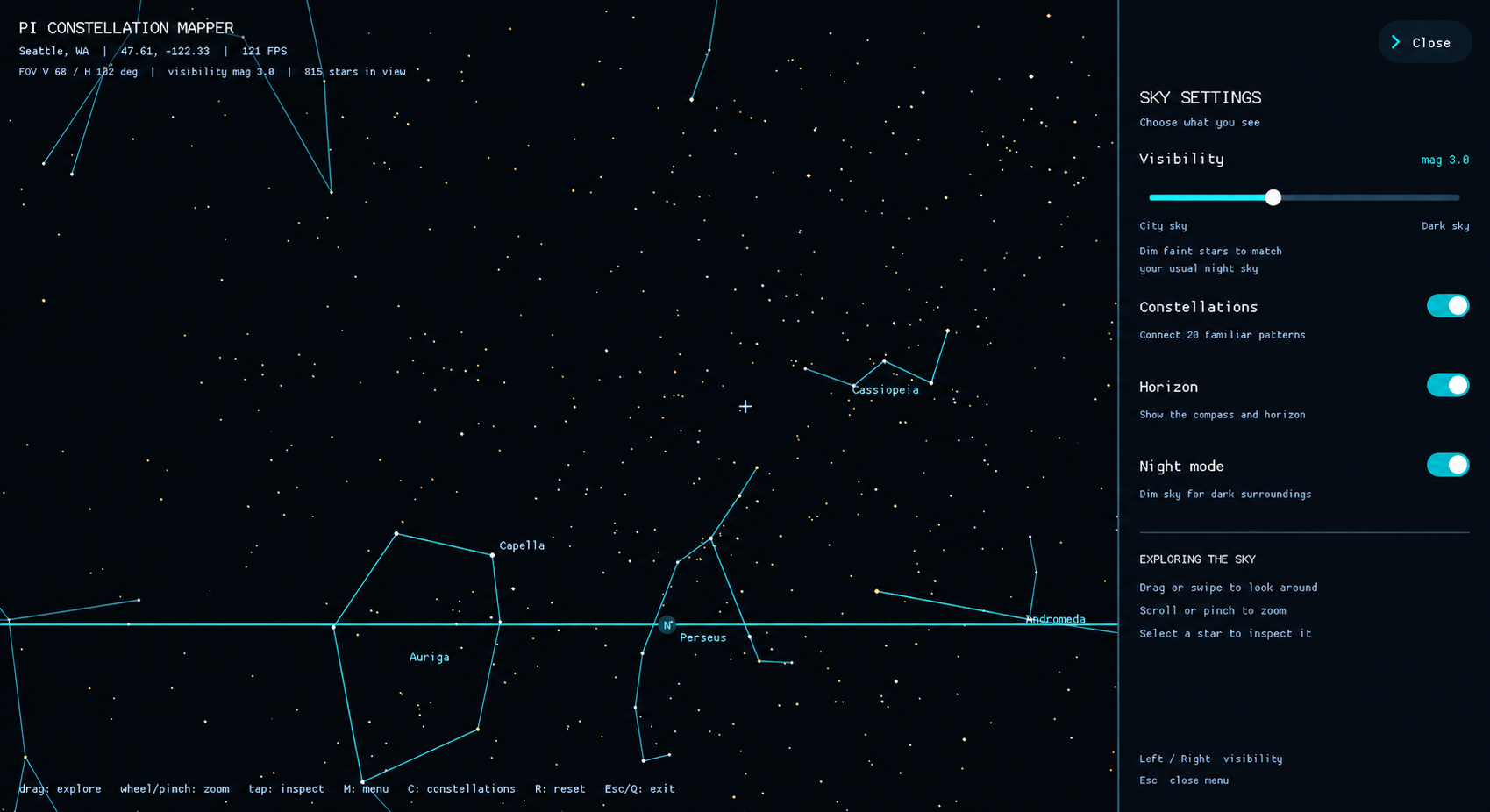
Pi Constellation Mapper showing a star field with labeled constellation outlines, a horizon guide, and a sky-settings panel.

The bright-star map with constellation overlays, a horizon guide, and sky settings. Screenshot enhanced for readability.

View full-size image (opens in a new tab)
The idea

Explore the sky.
Save what you see.

I’m developing a dedicated device for exploring the night sky and making constellations of your own. The intended experience is to find stars, connect them into a pattern, give it a name and story, and save it locally.

The Rust and Macroquad prototype displays a real bright-star catalog with touch and mouse controls. GPS and orientation sensors are planned to align the view with the device’s location and direction; the software currently uses a development location.

Hardware work includes component-fit and enclosure prototypes. Sensor integration, portable power, cooling, and outdoor testing remain part of the work ahead.

Explore the prototype branch on GitHub

A closer look

Interactive 3D
Placeholder / cube

Loading 3D preview…

Drag to rotate. Scroll or pinch to zoom. Arrow keys also rotate.

A cube for now. The mapper's model will live here as the project takes shape.

Hardware list

Prototype components

The documented prototype components and open hardware decisions. Listing a sensor here describes the hardware plan; GPS and orientation input are still awaiting software integration.

Pi Constellation Mapper components and open hardware decisions
PartQuantityRole & build notes
Raspberry Pi 5 · 8 GB1Runs the native Rust application and hosts the hardware interfaces.
Raspberry Pi Touch Display 2 · 5-inch1Primary display and touch input. On-screen zoom controls support the Pi’s touch-backend behavior.
Adafruit Mini GPS1Planned location and time input. Exact module revision and final connection details are not recorded.
Adafruit BNO085 IMU1Planned orientation and movement input. Calibration and the sensor interface are still to be integrated.
3D-printed enclosure prototypesNot recordedExplore component fit and handling. Final printed-piece count, material, dimensions, and fasteners are not documented.
Portable powerTo be selectedBattery, power regulation, charging hardware, and runtime targets remain open decisions.
CoolingTo be selectedFinal cooling solution and ventilation layout remain open decisions.
Cables, connectors & mounting hardwareNot recordedA final inventory of the display connection, sensor wiring, connectors, and fasteners is still needed.
Additional physical controlsUndecidedTouch is the current interface. Any additional buttons or controls remain a design decision.
Hardware plan on GitHub

Development log

Build notes & updates

Notes from the software and hardware work. The native prototype is on the prototype branch, with a draft pull request tracking the work.

Finding a usable enclosure

Working through 3D-printed enclosure prototypes with component fit and usability guiding the design. Power, cooling, sensor placement, and access to connections still need to come together in the final layout.

Build photos and enclosure files have not been added to this page yet.

Read the hardware plan

Touch controls and kiosk behavior

Added on-screen zoom controls and refined fullscreen behavior for the Touch Display 2. A kiosk setup helper configures the Raspberry Pi desktop’s labwc window rule and panel autohide so the application can use the display cleanly.

View the kiosk update

Getting the star map on screen

Started a native Rust and Macroquad prototype with a small catalog of real bright stars, sky-coordinate calculations, drag and swipe controls, zoom, and star inspection. The current time and a temporary observer location provide the first view while sensor integration is pending.

View the initial prototype

Defining the explore-and-create loop

Set the direction for a dedicated sky companion: explore real stars, connect them, name a constellation, and save its story. The hardware plan centers on a Raspberry Pi 5, a touch display, GPS, and orientation sensing.

Read the project vision